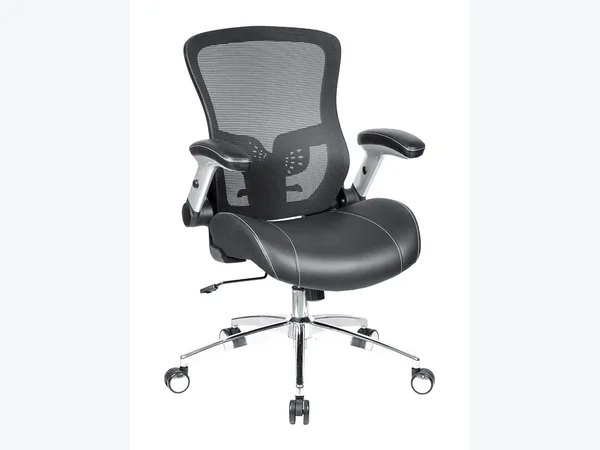
A retail buyer will not put a chair on the shelf without the right barcode, and a growing share will not accept it without an RFID tag either. This is one of those areas where a factory decision — printed onto the carton weeks before shipment — either fits your retailer's system or jams it. For office and mesh chair programmes headed to US retail, we settle the numbering before we print anything.
UPC and GTIN: get the number right at the source
The barcode on a chair carton encodes a GTIN — the global trade item number — usually shown as a 12-digit UPC in North America. The number itself belongs to you, the brand or importer: it is licensed from GS1 against your company prefix, not invented by the factory. Our job is to print it correctly, in the right symbology and the right place on the carton, at the right size so a store scanner reads it first time. The common failure is a factory making up a barcode or mis-printing the check digit; the store scanner rejects it and the pallet stalls. Send us your GTIN list mapped to SKUs and we apply them — we will not guess the numbers.
The RFID mandate is no longer just apparel
RFID used to be an apparel story. Not anymore. Walmart extended its RFID tagging mandate to home goods, sporting goods, electronics and toys with a deadline of 2 September 2022, and pulled more than a dozen further categories in by February 2024. Furniture sits squarely in scope for many programmes now. The technical shape matters: it is a Gen2 UHF tag in the 902–928 MHz band, and the EPC encoded on it is built from your UPC plus a unique serial number — so every single chair carries a distinct ID, not just a product code.
Who owns what
This trips buyers up, so let me be blunt about the division of labour. You own the GTINs and, where required, the RFID account and the EPC scheme — those are licensed to your company. We apply them: source compliant tags, encode them from the data you give us, and place and test the label so it reads on the line and at your retailer's dock. We can manage the tagging step as part of the pack; we cannot license your numbers for you.
Where the tag goes on a chair, and why it matters
A UHF RFID tag does not read well through metal or against a dense surface — the antenna detunes, and a tag buried under a steel base or pressed against a foam-and-metal seat can fail to scan at the retailer's portal. On a chair carton that means tag placement is an engineering choice, not a sticker slapped anywhere. We place it on a flat corrugate face with air or cardboard behind it, away from the gas lift and the base spider, and we read-test a sample from each batch so a placement that works on the bench also works at speed through a dock reader. A tag that scans 100 percent on the production line but 80 percent at the retailer's gate is worse than no tag, because now it is a compliance failure on record. Placement and read-rate verification are part of how we tag, not an afterthought.
The trade-off: tag now or sort it at the dock
Here is the honest call. Source-tagging at the factory — applying and verifying the RFID label as the chair is packed — costs a few cents per unit and a little lead time, and it has to be planned in. The alternative is letting the goods arrive untagged and having a third party tag them at the destination dock, which is slower, more expensive per unit, and a common cause of late deliveries to the store. If your retailer mandates RFID, source-tagging is almost always the cheaper end state even though it looks like an added factory cost. If they do not mandate it, tagging is wasted money — so tell us which it is.
Send us your GTIN-to-SKU list and your retailer's RFID requirement, and we will quote the barcoding and source-tagging into the pack. Reach the desk via the contact form or [email protected]. See how this fits a full programme on our audit and compliance page.