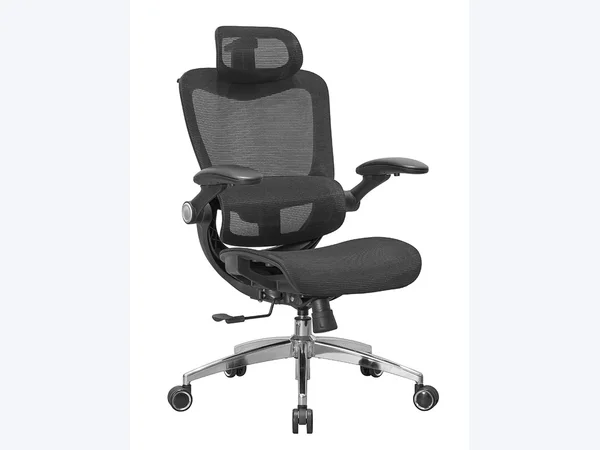
For a retail or e-commerce seller, a return is the most expensive sale there is — you pay the freight out, the freight back, the refund and the listing hit. So when buyers ask whether BIFMA testing is "worth it," I answer in return-rate terms, not certificate terms. Building our office and mesh chairs to a real cycle test is the cheapest insurance against the chair coming back. (Comparing BIFMA X5.1 against the European standard? ChairManufacturer.net has a practical guide on BIFMA vs EN 1335 for buyers sourcing across both markets.)
What the cycle tests actually do
ANSI/BIFMA X5.1 for general-purpose office chairs is not one test; it is a battery of around twenty, including cyclic and impact tests meant to compress years of use into a lab session. A weighted impactor — on the order of 225 lb — is dropped onto the seat thousands of times. The back is cycled through repeated reclines. The base, arms, casters and stability are loaded and pushed. The goal is to find the failure point on purpose, in a controlled rig, instead of discovering it under a real user.
Where chairs really break
The useful thing the testing teaches is where chairs fail, and it is rarely where buyers look. Failure almost never happens in the foam or the mesh surface. It happens at the seat-pan substrate or the mounting hardware — the structural plate under the cushion and the bolts that tie the seat to the mechanism. It happens at the base spokes and the gas-lift collar. Those are exactly the parts a price-cut quietly thins down, and exactly the parts a cycle test exposes. A chair that survives the impactor and the recline cycling is one that will not crack under a heavy user in month three.
Weight rating is a claim; the test is the proof
Listings love a headline weight rating — "holds 150 kg" — but a static number on a spec sheet tells you almost nothing about year-three durability. A chair can hold 150 kg standing still and still fail the cyclic test, because fatigue is about repeated load over thousands of cycles, not a single sit. This is the gap a price-only supplier hides in: same printed weight rating, thinner seat-pan plate, cheaper bolts, and the failure simply moves from the lab into the customer's home. When a buyer sends me a competitor's spec, the first thing I look for is whether the weight claim is backed by a cyclic test report or just asserted. We would rather quote a slightly higher chair with a real test behind the number than win on a rating that the chair cannot actually sustain. The number on the box should be one the rig has already proven.
The trade-off: test cost vs return rate
Here is the honest math. Booking a third-party BIFMA test on a representative sample costs real money and adds calendar time at the sample stage — there is no pretending otherwise. But measure it against the alternative. A structural failure that ships costs you returns, replacement units, two-way freight, and a review that suppresses the listing; importers who hold the line on X5.1-level construction consistently report lower return rates and a better total cost of ownership. The test is a few hundred to a few thousand dollars once; a two-point swing in return rate on a container of chairs is far more, every time you reorder. We would rather find the weak bolt on one sample than in a hundred customers' homes.
How we handle it
We build our chair platforms to BIFMA and EN construction and test methods, and third-party testing to X5.1 or EN 1335 can be arranged per order — booked at the sample stage so a failure is caught on one unit, not a shipment. We will not tell you a chair is "BIFMA certified"; we will tell you it is built to the construction we have passed before, and offer to prove it on your configuration in a lab. Those are different sentences, and the second is the true one until the report exists. This sits inside the OEM / ODM workflow and the wider retail compliance programme.
Tell us your target market, the duty level and your acceptable return rate, and we will recommend a construction spec and quote the testing option to back it. Reach the export desk at the contact form or [email protected].